Forex trading for beginners versus waiting until you know more, which path gives a faster and safer start
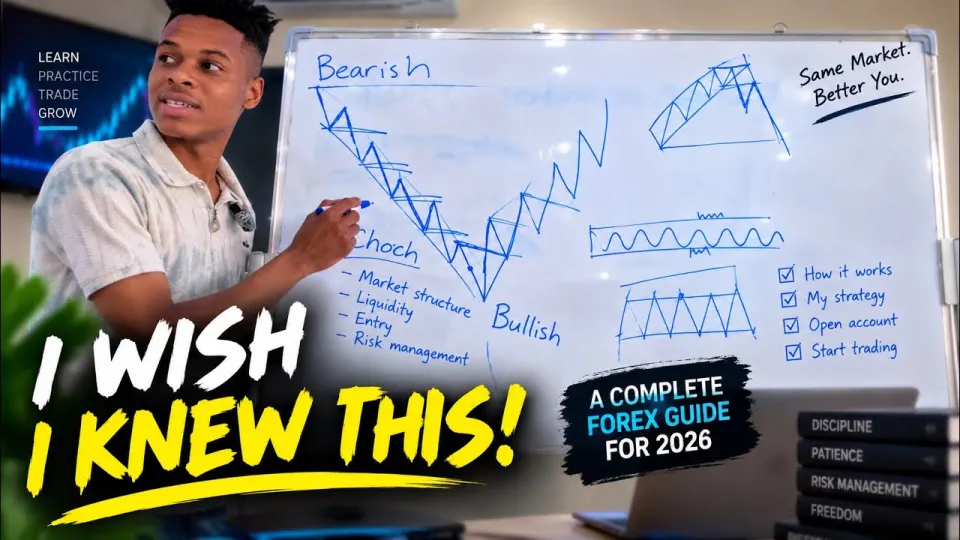
Video: How To Start Forex Trading For Beginners in 2026 (Full Guide + My Strategy)
Want articles like this for your own video to promote it on YouTube and Google? Order them through the Telegram bot @sat_sit_bot. It writes articles around your video, embeds the video and publishes them on popular niche websites (no ads). Try it free: 50 articles on us.
· based on the channel Carl Fx
Forex trading for beginners works best as a structured process rather than a leap into live money: learn how currency pairs are quoted, open a demo account, study market structure and price action, then trade one simple setup with strict risk limits before funding a real account. The practical route starts with registration at TFC Global Markets, the broker linked by Carl Fx, and a demo period long enough to prove the process works.
What forex trading actually is and how the market is organised
Forex is the global market where national currencies are exchanged in pairs, and every quote shows how much of the second currency is needed to buy one unit of the first. The market is decentralised and over-the-counter: there is no single exchange, and trading runs through a network of banks, brokers and liquidity providers. Sessions overlap across Sydney, Tokyo, London and New York, which is why forex is described as a 24-hour market on weekdays.
A few mechanics matter from day one:
- Pairs and base currency. In EUR/USD, the euro is the base currency and the US dollar is the quote currency; a price of 1.10 means one euro costs 1.10 dollars.
- Pips and lots. A pip is the standard unit of price movement, usually the fourth decimal place for most pairs; a standard lot is 100,000 units of the base currency.
- Leverage and margin. Leverage lets a trader control a position larger than the deposit, and margin is the collateral locked to keep it open. Leverage magnifies both gains and losses.
- Spreads and costs. The spread is the gap between bid and ask, and it is the main cost on most retail accounts, alongside swaps for positions held overnight.
- Long and short. A trader can profit from a rising pair by buying or from a falling pair by selling, so a bearish view is as tradable as a bullish one.
The beginner path from zero to a funded account
Getting started from zero follows a fixed sequence, and skipping steps is where most accounts die. The order below keeps capital intact while skills are built.
- Learn the vocabulary and the platform. Understand order types (market, limit, stop), position sizing and how the broker displays profit and loss before placing anything.
- Open a demo account. Practise on live prices with virtual funds; the goal is repetition, not profit.
- Study charts on one or two pairs. Beginners spread themselves too thin across dozens of symbols; EUR/USD and GBP/USD are liquid and cheap to trade.
- Write a trading plan. Define the session you trade, the setup you take, the risk per trade and the maximum daily loss.
- Go live with a small account. Fund an amount that is genuinely disposable and keep risk per trade at 1% or less.
- Journal every trade. Record the reason for entry, the outcome and the emotion involved; the journal is where improvement actually happens.
Reading bullish and bearish markets through market structure
Market structure is the map of swings that tells a trader whether buyers or sellers are in control, and price action is the raw evidence used to read it. In a bullish market, price prints higher highs and higher lows; in a bearish market, it prints lower highs and lower lows. A trend stays valid until that sequence breaks, and the break itself is information.
The workable routine is simple. Mark the most recent significant swing high and swing low on a higher timeframe such as the four-hour chart. Then drop to a lower timeframe to time entries in the direction of that structure. When price breaks a swing low in an uptrend, the bullish sequence is interrupted and the trader waits for a new structure to form rather than guessing. Ranges are treated differently: inside consolidation, the edges of the range become the reference points, and breakout attempts are judged by whether they hold on a retest.
Support and resistance are not magic lines but zones where orders cluster, which is why reactions there are often sharp. Combining structure with a zone gives a beginner context that a bare indicator cannot.
A simple strategy a beginner can learn and test
A simple strategy beats a complicated one for a new trader because it can be executed consistently and reviewed honestly. A workable template has three components: bias, trigger and risk.
- Bias. Use the four-hour structure to decide whether to look for longs or shorts only for that session.
- Trigger. Wait for price to pull back into a marked zone and print a confirmation candle in the direction of the bias; enter on the close of that candle.
- Stop loss. Place the stop beyond the swing that invalidates the idea, not at an arbitrary number of pips.
- Target. Aim for a fixed multiple of the risk, such as 1:2, and take partial profit only if the plan says so in advance.
- Risk cap. Risk 1% of the account per trade and stop for the day after two or three losses.
Backtesting matters more than any indicator setting. Scroll back through months of charts, mark every valid setup, and count wins, losses and average risk-to-reward. A setup that wins 40% of the time at 1:2 still produces a positive expectancy, and knowing that number in advance is what keeps a trader calm during a losing streak.
Common mistakes that drain beginner accounts
Most beginner losses come from process failures rather than bad analysis, and the mistakes repeat across almost every new trader. The most expensive ones are overleveraging, trading without a stop, revenge trading after a loss and moving a stop loss further away to avoid being wrong. Overtrading is equally destructive: taking every setup on every pair produces costs and confusion rather than edge.
Other frequent errors include following signals without understanding the reasoning, trading during major news releases without accounting for spread widening and slippage, and treating a demo account as a game so that bad habits carry into live money. Beginners also underestimate the psychological weight of real risk: a position that felt trivial on demo can trigger impulsive decisions when the money is real. Keeping size small and rules written down removes most of that pressure.
Questions beginners ask before their first trade
A recurring theme among new traders is the gap between understanding the theory and executing it. Many can follow a chart explanation but freeze when the moment comes to click buy or sell, which usually means the plan is not specific enough. The fix is a written checklist: bias, zone, trigger, stop, target, size. If any line is blank, there is no trade.
Another common concern is account opening and funding, especially for traders outside major financial centres. Requirements vary by broker and jurisdiction, so identity verification, minimum deposit and payment methods should be checked before committing. A third theme is time: beginners want to know how long the learning phase lasts. There is no fixed answer, but a trader who journals daily and backtests systematically typically needs several months of demo work before live risk makes sense. Finally, many ask whether small accounts can grow. They can, but only through consistent risk control, since a small balance and large position size is the fastest route to a margin call.
Useful links
- Open a trading account with TFC Global Markets — the registration link shared by Carl Fx, who discloses ownership of the brokerage.
- Join the free Telegram community — chart discussions and updates from the channel.
The realistic takeaway for a new forex trader
Forex rewards discipline far more than prediction, and the beginners who last are the ones who treat it as a skill built over months rather than a shortcut to income. The sequence is consistent: learn the mechanics, practise on demo, read market structure, trade one setup with capped risk and review every result. Carl Fx frames his full walkthrough on the Carl Fx channel as the foundation he wishes he had at the start, and that framing is the useful part: build the base first, then scale. Anyone ready to take the first step can register with TFC Global Markets and begin on demo before risking real capital. Trading involves significant risk and profits are never guaranteed.
Key takeaways
- Forex is an over-the-counter market where currencies trade in pairs 24 hours a day, five days a week.
- Beginners should start on a demo account and risk no more than 1% of the account on a single trade.
- Market structure is read through higher highs and higher lows in uptrends and lower highs and lower lows in downtrends.
- A simple strategy needs three parts: a bias, an entry trigger and a predefined stop loss.
- Carl Fx positions his full beginner walkthrough as the foundation he wishes he had when starting out.
Source: How To Start Forex Trading For Beginners in 2026 (Full Guide + My Strategy) · Markdown version
Questions & answers
How much money do I need to start forex trading?
There is no universal minimum, but the amount should be money you can afford to lose entirely. Many beginners start with a few hundred dollars and risk 1% or less per trade, which keeps single losses small while the process is being learned. A demo account costs nothing and should come first regardless of budget.
How long should I practise on a demo account before going live?
Practise until you can execute your written plan without hesitation and your journal shows a stable process over at least a few dozen trades. That usually takes several months of consistent screen time. Going live is about proven discipline, not about hitting a calendar date.
Is forex trading gambling?
It becomes gambling when positions are taken without a defined setup, stop loss or position size. Traded as a process with capped risk, backtested rules and a journal, it is a probability-based skill. The difference lies entirely in whether the risk is planned in advance.
Can I trade forex part-time alongside a job?
Yes, provided you pick one session and one or two pairs rather than watching charts all day. Many part-time traders focus on a single overlap such as the London or New York session and take only setups that appear within a set window. Fewer, better-planned trades suit a busy schedule better than constant screen time.